
What Is Dal Bhat?
Dal Bhat (दाल भात) — literally ‘lentils and rice’ — is the national dish of Nepal and the daily meal of most Nepali people, eaten twice a day: once in the late morning and once in the evening. It is not simply a dish. It is a nutritional system, a cultural institution, and a way of life that has sustained Nepali communities for centuries across the Himalayas, the hills, and the Terai.
A full Dal Bhat meal typically consists of: steamed rice (bhat), lentil soup (dal), vegetable curry (tarkari), pickle (achar), and often a side of fermented greens (gundruk) or papad. In meat-eating households, a small portion of meat curry (masu) may also be served.
Why Do Nepali People Eat Dal Bhat Every Single Day?
1. Complete Nutrition in a Single Meal
Dal Bhat is nutritionally complete in a way that few traditional meals are. Rice provides carbohydrates and energy. Dal (lentils) provides protein and iron. Tarkari (vegetable curry) provides vitamins and fibre. Achar (pickle) provides probiotics and micronutrients. Together, they form a balanced meal that sustains physical labour, mountain trekking, and farming — the demands of daily Nepali life.
This nutritional completeness is not accidental — it evolved over generations of people living in challenging mountain environments where food needed to be sustaining, affordable, and available. Dal Bhat achieved all three.
2. It Is Deeply Affordable
The core ingredients of Dal Bhat — rice, lentils, and seasonal vegetables — are among the most affordable foods in Nepal. Lentils in particular are a low-cost, high-protein food that can be grown, stored, and cooked with minimal resources. For a country where a significant portion of the population has historically lived on limited income, Dal Bhat represents the most efficient nutrition possible per rupee spent.
3. It Provides Sustained Energy
The combination of slow-digesting rice carbohydrates and plant protein from lentils produces a steady, sustained energy release — ideal for the physical demands of Nepali daily life. Farmers, porters, trekking guides, and labourers all rely on Dal Bhat’s energy for long days of physical work. This is where the famous Nepali saying comes from:
“Dal Bhat power, 24 hour.”
This phrase — widely used by Nepali trekking guides and porters — captures the genuine belief that Dal Bhat provides energy that lasts through the most demanding physical days.
4. Cultural Identity and Comfort
Beyond nutrition, Dal Bhat carries profound cultural meaning. Eating Dal Bhat twice a day is a cultural practice that connects Nepali people to their heritage, their families, and their homeland. For Nepali diaspora communities in the UK, eating Dal Bhat regularly is an act of cultural continuity — a way of staying connected to Nepal even thousands of miles away.
There is also the deep comfort of familiarity. Dal Bhat is what Nepali people grew up eating, what their parents and grandparents ate, and what feels like home. No restaurant meal or foreign cuisine quite replaces it.
5. Infinite Variety Within the Framework
While the structure of Dal Bhat is consistent — rice, dal, tarkari, achar — the specific dishes within that structure change constantly with the season, the region, and the household. The dal might be masoor, toor, chana, or a combination. The tarkari changes with the season — cauliflower in winter, bitter gourd in summer, spinach in spring. The achar varies from fresh tomato to fermented radish to timur (Sichuan pepper) chutney. This infinite variation within a consistent structure means Dal Bhat never truly becomes monotonous.
6. It Scales for Every Occasion
Dal Bhat is the meal for every occasion in Nepal — from a simple weekday lunch to a full feast. For daily meals it is plain and functional. For guests or celebrations, additional dishes are added: meat curry, richer dal, more elaborate tarkari, sweet dishes. The structure remains the same but the occasion changes what fills it.
Regional Variations of Dal Bhat Across Nepal
- Hilly and mountain regions: Dhindo (buckwheat or millet porridge) sometimes replaces rice; lentils are earthier and more robust
- Terai (lowland) Dal Bhat: More similar to North Indian dal-chawal; often uses toor dal and more chilli
- Newari Dal Bhat: Part of the elaborate Newari feast tradition; accompanied by more dishes and often includes beaten rice (chiura)
- Sherpa and Tibetan-influenced: Thukpa (noodle soup) may appear alongside or instead of rice
Dal Bhat in the UK Nepali Community
For Nepali communities in the UK — many of whom came as Gurkha soldiers and their families, or as students and workers — Dal Bhat remains the daily meal of choice. UK South Asian grocery stores carry all the necessary ingredients: basmati or medium-grain rice, various lentils (masoor, toor, chana), mustard oil, timur, and Nepali spice blends.
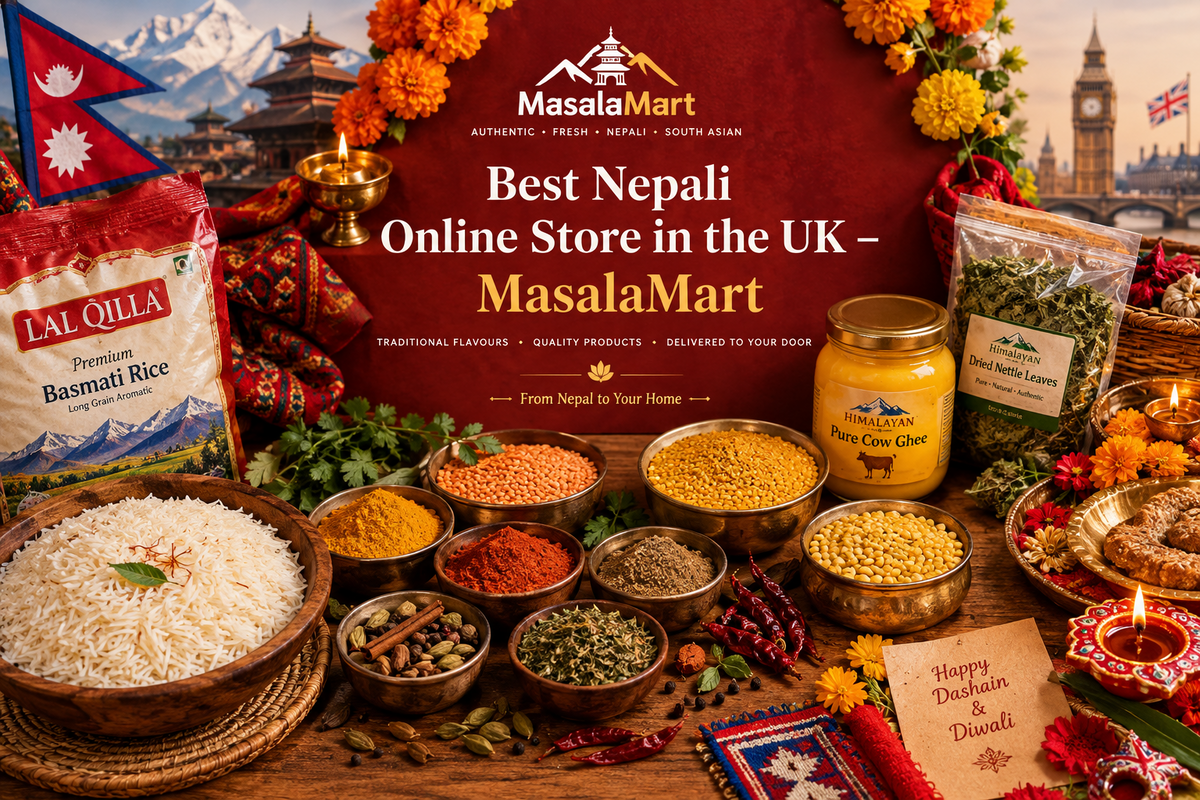
At MasalaMart, we stock the essential Dal Bhat ingredients specifically chosen for the UK Nepali community — from the right lentils to mustard oil, gundruk, and Himalayan Wai Wai noodles for a complete Nepali kitchen, delivered across the UK.
How to Make a Simple Nepali Dal for Dal Bhat
A basic Nepali dal is simpler than Indian dal tadka — it is thinner, lighter, and more soupy. Boil masoor or toor dal until soft. Season with turmeric and salt. Make a tadka of mustard oil, cumin seeds, garlic, and dried red chilli — pour sizzling over the dal. Serve over steamed rice with a vegetable tarkari and achar. That’s Dal Bhat.
Where to Buy Dal Bhat Ingredients in the UK
Masoor dal, toor dal, mustard oil, timur, and Nepali grocery essentials are available at MasalaMart — delivered across the UK with free delivery on orders over £50.